- Dividend-increase announcements in Q1 2026 reached their highest level since 2019, reflecting broad boardroom optimism despite macroeconomic uncertainty.
- A sharp divergence has emerged as mega-cap titans aggressively hike payouts (60%+ increase rate), while small-cap firms hoard cash in anticipation of tighter credit conditions.
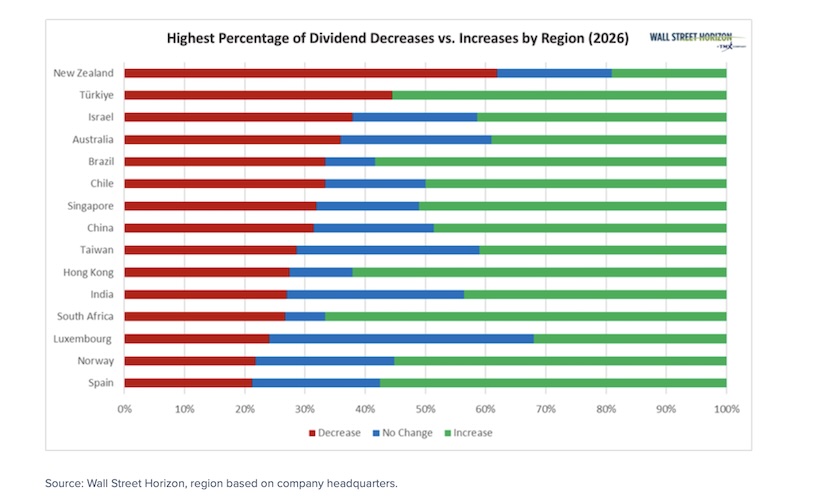
- While most western countries remain resilient, broader dividend cuts have formed in the Asia-Pacific and Oceania regions, led by significant retreats in Hong Kong, Singapore, and Australia.
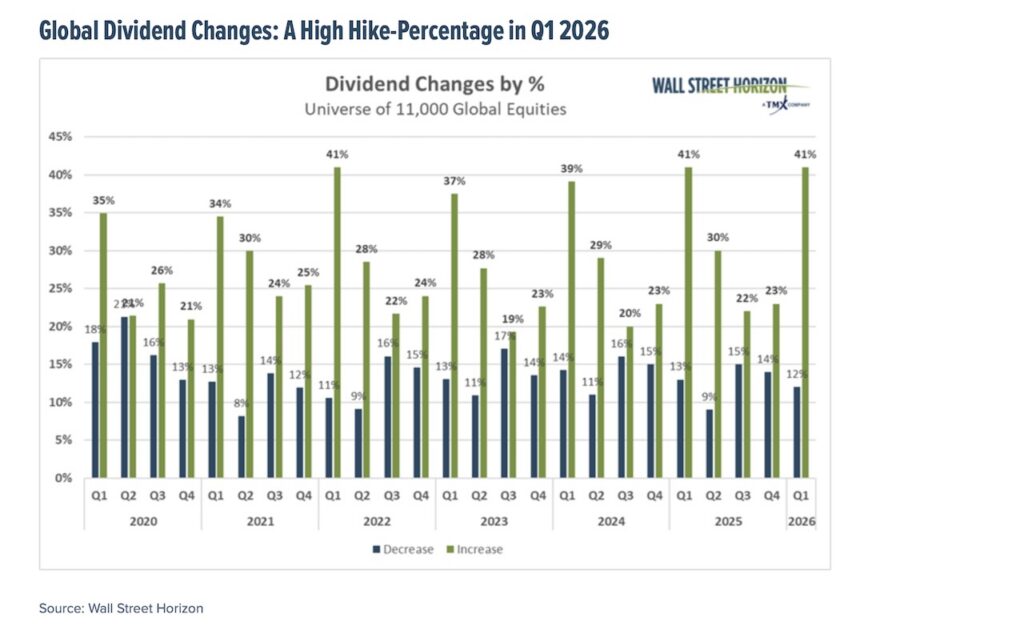
As Q1 2026 comes to a close, we follow up on an article we published last week on buybacks by analyzing corporations’ other favorite way to return value to shareholders.
The percentage of companies increasing dividends in Q1 was the highest level since Q1 2019 (45%). With 41% of dividend announcements denoting an increase, Q1 2026 tied with levels seen in Q1 2025 and Q1 2022.
This suggests boardrooms are still optimistic about cash flows in 2026, as they enter the year with stronger balance sheets and positive earnings forecasts.
Global Dividend Changes: A High Hike-Percentage in Q1 2026
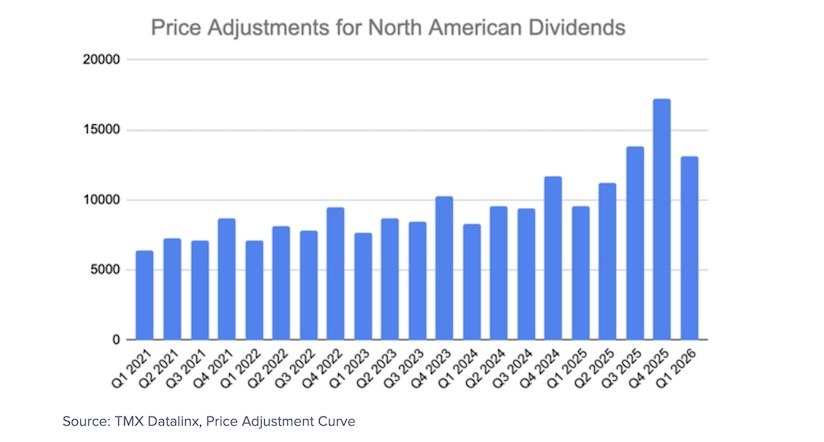
More dividend payouts mean investment teams need to adjust stock prices to reflect these corporate actions properly in order to conduct time-series analysis. TMX’s Price Adjustment Curve (PAC) provides price adjustments applicable down to tick level prices or even orders, and below you can see the number of recorded adjustments for North American dividends have been steadily increasing. Q4 2025 recorded 17,229 such price adjustments, the largest quarterly tally in our five years of data. Q1 2026 ended with 13,137 price adjustments, the third largest amount.
A Dividend Divide: Large-Cap Confidence vs. Small-Cap Restraint?
Large Caps
While corporate confidence appears resilient among the world’s largest giants, a deeper look at the data reveals a growing divide between the mega-cap leaders and smaller, more cautious firms. The start of 2026 has been marked by a show of strength from global heavyweights.
The most notable hikes this year have been from industry titans such as Taiwan Semiconductor (TSM), AstraZeneca (AZN), HSBC Holdings (HSBC), and Verizon (VZ). For these companies, the message seems to be “We have more cash than we know what to do with, and we are confident in the year ahead.” Companies with market capitalizations over $10B (large cap) and $200B (mega cap) are leading the charge, with over 60% of them reporting increases. This indicates that industry leaders are prioritizing shareholder returns and possess the cash flow stability to do so.
Small Caps
While the giants are hiking, the rest of the market is being notably more conservative. Small-cap companies (under $2B) only managed a 38% increase rate, with a high percentage of “No Change” announcements (43%). This suggests that smaller firms are bracing for tighter credit conditions or slower growth and are choosing to hoard cash rather than reward shareholders.
Selective Cuts: High-Profile Retreats and Regional Shifts
Perhaps the most interesting part of the story is the 11% of companies that cut their dividends. Even among the large caps, we saw some surprising retreats. High-profile names like China Mobile, ING Groep and Barclays recorded decreases in this period.
Regionally, countries like New Zealand, Türkiye, Israel, Australia and Brazil saw a higher frequency of dividend cuts vs. dividend increases, suggesting that cash preservation is top of mind in other parts of the world.
The Bottom Line
Dividend-increase announcements are tracking above year-ago levels and 2024’s pace. Even with shakiness in the labor market and the uncertainty caused by the Iran war, shareholders are being rewarded with growing quarterly payouts.
We’ll find out more in the weeks ahead—first from next week’s employment numbers, and second as first-quarter earnings reports roll in (assuming we are sticking with quarterly updates!).
Twitter: @ChristineLShort
The author may hold positions in mentioned securities. Any opinions expressed herein are solely those of the author, and do not in any way represent the views or opinions of any other person or entity.