- The US ETF market is pacing toward a historic launch record in 2026, driven by 1,023 new product debuts in the first eight months alone (52% YoY growth), alongside near-record inflows
- With 169 ETF delistings logged through the first three quarters and Q4 historically serving as the peak period for fund liquidations, 2026 is on track to potentially mark the highest annual closure volume since 2018
- Rather than signalling weakness, rising delistings reflect a hyper-efficient marketplace where issuers rapidly retire underperforming or low-liquidity strategies to reallocate resources toward proven investor demand
The exchange-traded fund (ETF) market is pacing toward a record-breaking year in 2026, driven by an unprecedented wave of new product launches and historic capital inflows. In the first eight months of 2026 alone, 1,023 new ETFs debuted on major exchanges (a 52% jump from the same period last year), while total year-to-date inflows are on the verge of clearing an annual record at $1.47 trillion.1
Coming on top of the banner record set in 2025, this relentless expansion underscores how deeply embedded ETFs have become across both retail and institutional portfolios.
The driver behind this sustained appetite lies in ETF’s unmatched flexibility, liquidity, and tax efficiency compared to traditional investment vehicles. Active ETFs have seen particularly explosive growth, capturing a massive share of new allocations as traditional asset managers continue converting mutual fund strategies into ETF structures. While passive, index-tracking funds still form the core foundation of long-term portfolios, active ETFs give managers room to navigate volatile macro environments, implement option-overlay income strategies, and offer targeted thematic exposure.
This rapid shift toward active management has spurred a continuous cycle of product innovation, and with it, a faster rate of product turnover.
ETF Attrition Accelerates: What’s Behind the Delisting Surge?
Parallel to the historic launch pace, ETF delistings are mounting quickly. According to Wall Street Horizon data, the current tally for 2026 ETF delistings has already reached 169 through the first three quarters (data as of September 21, 2026). This compares to 188 closures in 2025, 169 in 2024, and 214 in 2023. Historically, the fourth quarter stands as the most active period for fund liquidations, as asset managers routinely clean up balance sheets, rationalize product lines, and optimize tax-loss harvesting profiles prior to year-end. With Q4 still ahead, 2026 is on track to potentially become the highest annual delisting period in Wall Street Horizon’s dataset dating back to 2018.
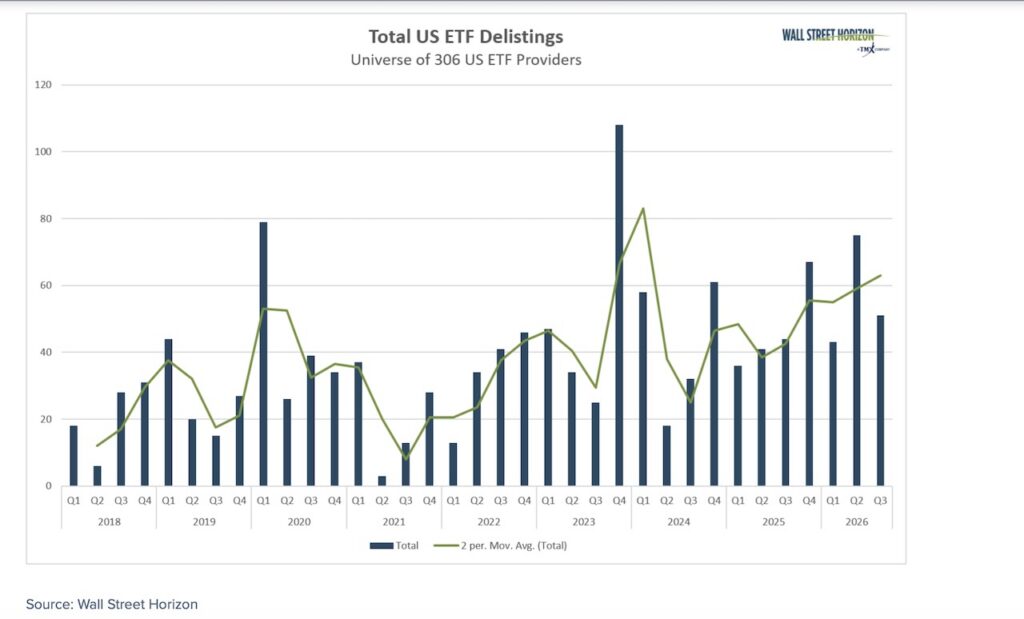
What is driving this elevated delisting activity? It is primarily a function of the sheer volume of product launches seen over recent years, coupled with structural shifts in issuer behavior, evolving macro conditions, and shrinking tolerance for underperforming funds. With hundreds of niche and thematic funds hitting the market annually, issuers are running aggressive product experiments. If a strategy fails to gather meaningful AUM or establish trading liquidity within 12 to 24 months, providers are increasingly swift to pull the plug rather than subsidize non-viable funds.
Rather than viewing these elevated delisting numbers as a sign of industry distress, analysts increasingly interpret them as evidence of a hyper-efficient marketplace. The modern ETF ecosystem operates with a high degree of darwinism: capital moves rapidly to winning strategies, while unsuccessful products are systematically cut to make way for new ideas.
The Bottom Line
The record setting 2026 ETF landscape highlights a market defined by both rapid expansion and constant refinement. As asset managers roll out record numbers of active and specialized products to capture historic inflows, the margin for underperforming funds has narrowed significantly. The rising tide of delistings reflects an industry that is both highly competitive and structural in its discipline, quickly retiring stagnant strategies to make room for market-driven innovation. For custodians, data providers, and back-office teams, tracking this accelerating product lifecycle, from launch to final payout, remains imperative.
Sources:
1 “A Record ETF Year Takes Shape as Inflows Near $1.5 Trillion,” ETF.com, Sumit Roy, September 21, 2026, https://finance.yahoo.com
Twitter: @ChristineLShort
The author may hold positions in mentioned securities. Any opinions expressed herein are solely those of the author, and do not in any way represent the views or opinions of any other person or entity.