- Secondary offerings surged to a five-year high in Q2, as AI hyperscalers race to raise capital
- Despite strong earnings, investors are punishing heavy capex plans, with free cash flow favored over intense investment
- A slowdown in equity issuance and AI spending growth could mark an important shift in market leadership during the second half of the year
Cash is king. Not for investors right now, but among the hyperscalers. The craving for capital is high as the AI arms race takes new twists and turns.
According to Wall Street Horizon’s corporate event data universe spanning more than 11,000 global companies, Q2 2026 featured the most secondary equity offerings in five years.
The sum (more than 100 announcements) brought the four-quarter figure to above 90 on a per-quarter basis, also the most since 2021.
5-Year High In Secondary Offerings
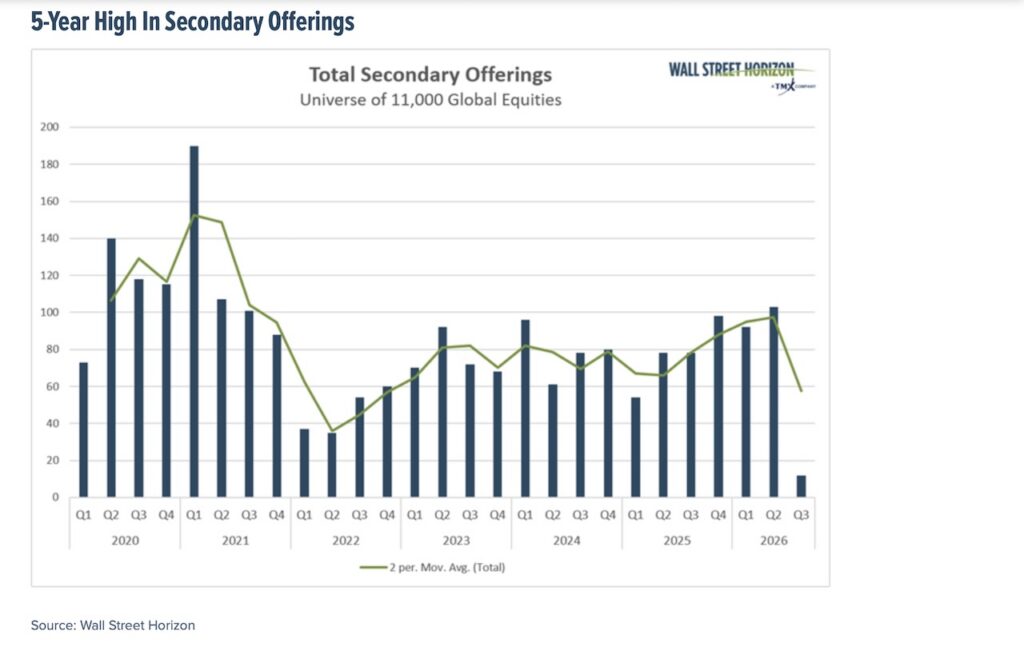
Why is this factoid more than just fascinating for investors? Well, the 180-turn currently being pulled by large companies from around the world is not so shareholder-friendly. Indeed, along with surging secondary issuance volumes, stock buybacks are less en vogue among the most valuable tech firms.
Tech-media-telecom’s total shareholder yield turns more paltry with each passing week, despite names like NVIDIA (NVDA) and Microsoft (MSFT) being the largest dividend payers in market history (high dollar-value payouts, but small yields).
The Market Is Voting Against Capex
Bookmark the above chart. It could prove to be a warning signal, a yellow flag that companies have become too focused on capex. Market reactions to Q2 earnings reports seem to support that conjecture, with the heavy hitters reporting Wednesday and Thursday nights.
“M&M” Microsoft (MSFT) and Meta Platforms (META) post numbers this afternoon, while “A&A” Apple (AAPL) and Amazon (AMZN) issue revenue and profit figures tomorrow after the market closes. These reports come after solid Alphabet (GOOGL) earnings and Intel (INTC) results, but those two tech giants saw their respective stock prices decline following financial news hitting the tape. That’s been the theme this reporting period: great earnings, lackluster reactions.
Is Mr. Market sending a message? That nastygram might be that spending linked to the AI and data-center buildout has blown at least a minor gasket. Step back in time a few quarters, and the zeitgeist was “the more spending the better.” Take on debt, issue equity… do whatever it takes to get a leg up on the competition.
Not so today. Not only have “capex beats” been punished, but so too has the broad tech sector. Through Monday, the S&P 500 Information Technology Sector ETF (XLK) was pacing for its worst month since September 2022, during what has typically been a bullish calendar stretch.
A few weeks ago, we noted that this earnings season could be more like “capex season.” While plenty of pivotal reports are not yet in hand, it wouldn’t be surprising to see AI hyperscalers chart a course change (not totally reverse ship) in light of how investors are responding to record-setting capex figures. If that’s the case, the above chart could be among the initial tells. A drop in secondary equity announcements may reveal at least a modest return to the shareholder-first mindset that dominated the pre-AI era.
Apple’s Different Playbook
Maybe the likes of GOOGL, MSFT, META, AMZN, Oracle (ORCL), and even Tesla (TSLA) & SpaceX (SPCX) will mimic AAPL. As CEO Tim Cook hands the reins over to John Ternus, Cupertino once again claims the crown as the world’s most valuable company. Its market cap leapfrogged NVDA’s to begin the week as semiconductor-stock selling ramped back up.
Apple (by design or by happenstance) has largely stayed on the AI-capex sidelines, choosing to preserve free cash flow and its pristine balance sheet, and it has now king of the hill. It’s a clear sign that heavy investment spending is no longer a financial virtue. We’ll get all the Q2 details Thursday evening. Watch revenue and earnings, of course, but listen for the company’s AI plans (if any) and possible comments from its incoming chief.
Semiconductor stocks seem to already be pricing in lighter hyperscaler capex growth rates. The VanEck Semiconductor ETF (SMH) continues flirting with technical bear-market territory, notching fresh lows dating back to early May this week. While lower spending by the aforementioned mega-caps would boost that group’s free cash flow, such a trend would mean lower revenue for NVDA, Broadcom (AVGO), and likely international juggernauts Taiwan Semiconductor (TSM), SK Hynix (SKHY), and Samsung.
To be clear, aggregated company forecasts still point to increased capex in the quarters to come. A mere slowing of spending growth compared to current estimates, however, would get a lot of attention.
Watch the Early Warning Signals
Along with noting secondary equity announcements, be on the lookout for a possible uptick in preliminary updates. IBM (IBM)’s cautionary pre-announcement earlier this month sent shockwaves through tech, but shares were tame after the full Q2 report was digested. The corporate takeaway? Companies may be better served by waving an early red flag than risking it, and dumping a lackluster report and drastically weak guidance onto the Street. Believe it or not, IBM has rallied almost 10% off its July low as XLK struggles.
There’s another side to the capital-raising coin. Issuing debt is usually a lower-cost financing method. The downside is that a firm becomes more leveraged, and if operating performance turns south, traders quickly gauge a borrower’s credit default swaps for clues on solvency (see: ORCL).
We’ll leave it to CEOs and CFOs to determine the proper capital structure. As investors and analysts, we have plenty of tools to pick out the winners from the losers, including key updates served up in August as the corporate conference season heats back up.
The Bottom Line
Secondary issuance announcements have risen to half-decade highs… levels not seen since the speculative boom of early 2021. The AI arms race is at the heart of the matter, though strains on small- and medium-sized companies must also be acknowledged amid rising global interest rates. Keep that secondary issuance chart in your back pocket, and we’ll be sure to provide updates as the second half unfolds.
Twitter: @ChristineLShort
The author may hold positions in mentioned securities. Any opinions expressed herein are solely those of the author, and do not in any way represent the views or opinions of any other person or entity.