- Record back-to-school spending is expected, with higher electronics prices and resilient household demand shaping the retail landscape
- A wave of major consumer earnings reports and fresh retail sales data will offer investors key insights into household spending trends
- Corporate guidance and management commentary may prove just as important as the hard data in assessing the consumer outlook
The dog days of summer are upon us, and global stocks are not far from record highs despite a plethora of macroeconomic volatility catalysts in recent weeks. From oil’s pop and drop to a hedge fund blowup to a wishy-”washy” July Fed meeting, equities have hung in there. Still, historical data point to possible downside from now through early October ahead of the U.S. midterm elections.
That’s what’s on investors’ minds at the moment. Households, however, are perhaps more focused on back-to-school shopping. Yes, the final handful of summer weeks ushers in shorter days and longer shopping lists for parents across continents.
All told, consumers appear to be in decent shape to weather steeper costs for classroom and dorm room essentials. We’ll get into all the nuggets, but U.S. retail sales data have been firm lately, and (hopefully) easing gas prices may support spending in the back half of 2026.
Record Sales Forecasts… With Some Tech Sticker Shock
According to the National Retail Federation (NRF), total back-to-school spending is set to rise to a record $1.468 billion. If that sounds like a whopper of a number, you’re not crazy. NRF data reveal that the back-to-school season now generates more consumer outlays than the winter holidays. This year, though, offers a fresh and not-so-pleasant tech twist.
You see, shopping for college is the larger driver, and much steeper costs for electronics will likely put upward pressure on the overall amount. To wit, Apple (AAPL) recently announced price hikes on its laptops, tablets, and smartphones.
The Box Office Bellwether
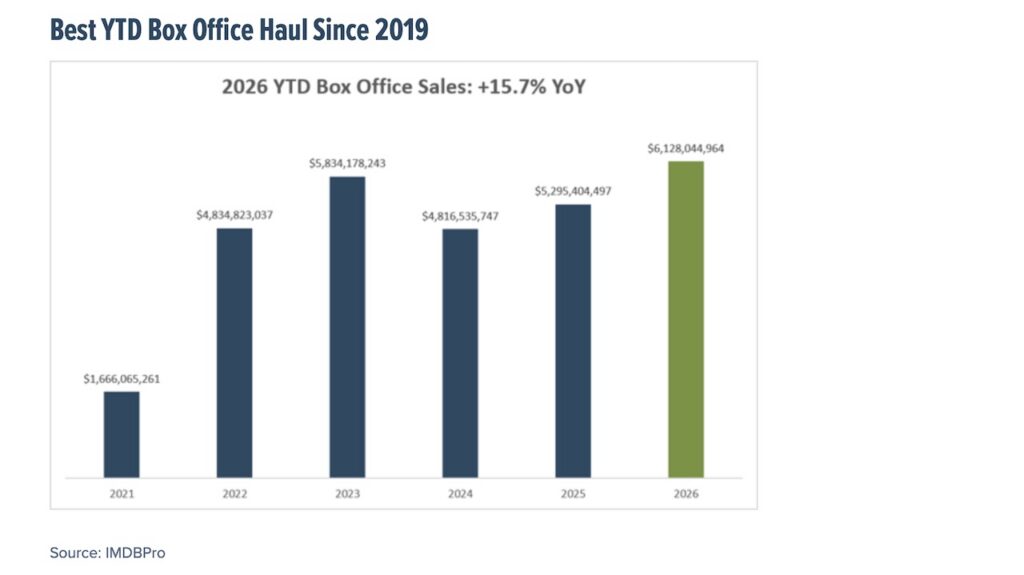
Whether higher Mac and PC price tags ultimately dent broader consumer demand remains to be seen. One real-time gauge of discretionary spending is the box office, and so far, moviegoers haven’t flinched. Spider-Man: Brand New Daybrought in $927 million in its debut weekend, good enough for the No. 2 spot in global ticket sales, following The Odyssey’s major July success. All told, the domestic box office has scored $6.128 billion YTD, up 15.7% from this time a year ago, according to IMDbPro.
Best YTD Box Office Haul Since 2019
Lights, Camera… Earnings!
Eyes now shift from the theater to the checkout line. We won’t see the final seasonal spending numbers for quite some time, but retailer Q2 reports hit the tape later this month. Wall Street Horizon’s earnings calendar shows that Home Depot (HD) leads off with May-through-July numbers crossing on Tuesday morning, August 18. Rival Lowe’s (LOW) prints the following day, along with discounter TJX Companies (TJX) and the suddenly outperforming Target (TGT).
Then, on Thursday, August 20, Walmart (WMT) and Ross Stores (ROST) report Q2 revenue and profits. The final full week of August includes quarterly updates from Dick’s (DKS), Kohl’s (KSS), Burlington (BURL), Dollar General (DG), and The Gap (GAP).
Costco (COST) issues monthly interim sales data on today, August 5, and Wednesday, September 2, AMC.
July Retail Sales Comes Before Earnings
Before retailers report, investors get one more critical read on the consumer. The U.S. Census Bureau releases its Retail Sales report before the bell on Friday, August 14, and another healthy print would reinforce the notion that households remain resilient.
Recall that annual May and June spending rose about 7% YoY, sharply outpacing inflation. Recent card data from Bank of America and JPMorgan Chase also point to a broadening of consumption, helping to ease fears of a worsening “K-shaped” economic backdrop.
June Retail Sales Rose 0.2%, With the YoY Rate Reaching +6.7%
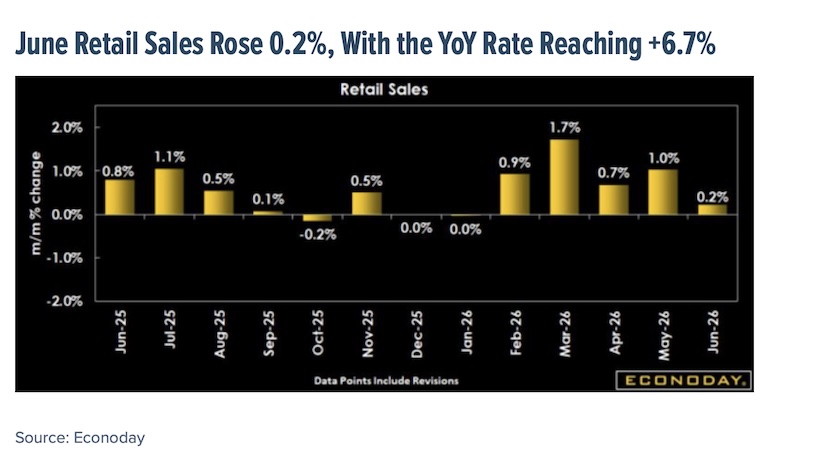
All the while, Johnson Redbook retail sales largely support this generally firm household spending backdrop. Following a bump likely related to the World Cup, America 250, and lingering tax refunds, the high-frequency weekly gauge points to 8%+ year-over-year growth.
Keying In on the Commentary
All told, the data appear solid. But investors know that commentary from CEOs and their fresh takes on emerging trends sometimes matter more. We’ll get a bevy of outlooks and forecasts in the next few weeks. Unfortunately, investors and Wall Street analysts won’t get many chances to ask pointed questions at industry events, as consumer and retail conferences are sparse until after Labor Day.
So, keep your eyes peeled for our mid-Q3 Investor Conference article; we’ll be sure to profile upcoming Consumer Discretionary and Consumer Staples events that could move individual retailer stock prices, and maybe even the market.
Resilient Stock Prices
Despite the dearth of gatherings, confidence is growing that consumer company executives are more sanguine today than, say, five months ago. The tariff situation has fewer question marks; oil prices are down sharply after the springtime surge; and the labor market might very well be firming. It’s not just sentiment, either.
Just take a look at the SPDR S&P Retail ETF (XRT). It’s close to multi-year highs and has been outperforming since mid-May. At the sector level, Consumer Staples has returned 10% YTD, while the equal-weight Consumer Discretionary ETF (RSPD) is attempting to notch multi-month highs of its own.
The Bottom Line
This time of year almost always offers new consumer clues. Back-to-school and back-to-college shopping is a critical stretch, and it often portends how the holiday shopping season will perform. Be on the lookout for major retailer earnings reports starting mid-month, followed by September consumer conferences. As always, hard data and corporate boardroom language must be weighed together in order to gain an edge.
Twitter: @ChristineLShort
The author may hold positions in mentioned securities. Any opinions expressed herein are solely those of the author, and do not in any way represent the views or opinions of any other person or entity.