- The global equity arena is filled with big winners and big losers as AI infiltrates industries
- Traditional split announcements have slowed, with the historically pivotal Q2 ahead
- Despite near record-high stock prices, reverse splits are notable, as it’s as much a K-shaped market as it is a K-shaped economy
Dispersion is the word of the year. Thirty-six trading days into 2026, and there are 52-week highs and 52-week lows across the global equity spectrum. Sectors like Information Technology (specifically the software industry) and Financials have been hit by the heat-seeking missile that is AI disruption.
Drawdowns of 40% or more are seen in names like Salesforce (NASDAQ: CRM), Intuit (NASDAQ: INTU), and ServiceNow (NOW). But other areas, including Energy, Materials, and Consumer Staples, trade like beach balls bears are trying to keep underwater. The bifurcation is real.
Domestic SMIDs & Ex-US Surge While the Mag 7 Stall
Across sizes, U.S. mid- and small-cap stocks have sharply beaten the S&P 500 Index (INDEXSP: .INX) as we wrap up February. They are higher by 7–8% YTD as the SPX churns in a stubborn 2–3% range over the past two months. NVIDIA (NASDAQ: NVDA) earnings are on tap, while many multinational corporations determine new strategies in light of the Supreme Court striking down President Trump’s IEEPA tariffs. Within the Magnificent Seven, only NVDA is materially positive in 2026—up just 3% before Wednesday night’s Q4 report.
And then there’s the geographic story. Much has been made about the S&P 500’s worst start to a year compared to the ex-U.S. index in the last three-plus decades. Indeed, almost all of the dozens of individual country ETFs are solidly in the green YTD. Throw a dart at the globe, and chances are you’ll land on a hot market.
Haves and Have-Nots
In short, it’s difficult to recall a time when there have been so many winners and losers at once. That brings us to this week’s feature: stock splits.
Often, traditional stock splits are announced when shares surge quarter after quarter. Conversely, reverse stock splits serve as a last resort of sorts among embattled companies in struggling sectors and industries.
We’ve seen both types lately, and with many consumer company earnings reports on tap, more may be on the way.
When Splits Speak: Corporate Signals in Focus
For a brief refresher, a traditional stock split increases the number of shares outstanding, lowering the price per share proportionally. For instance, if you owned 100 shares at $100, after a 2-for-1 split, you would own 200 shares at $50. Your financial stake and the company’s books are unchanged.
A reverse split reduces the number of shares outstanding, raising the stock price proportionally. So, if you owned 1,000 shares at $1, after a 1-for-10 reverse split, you’d have 100 shares at $10.
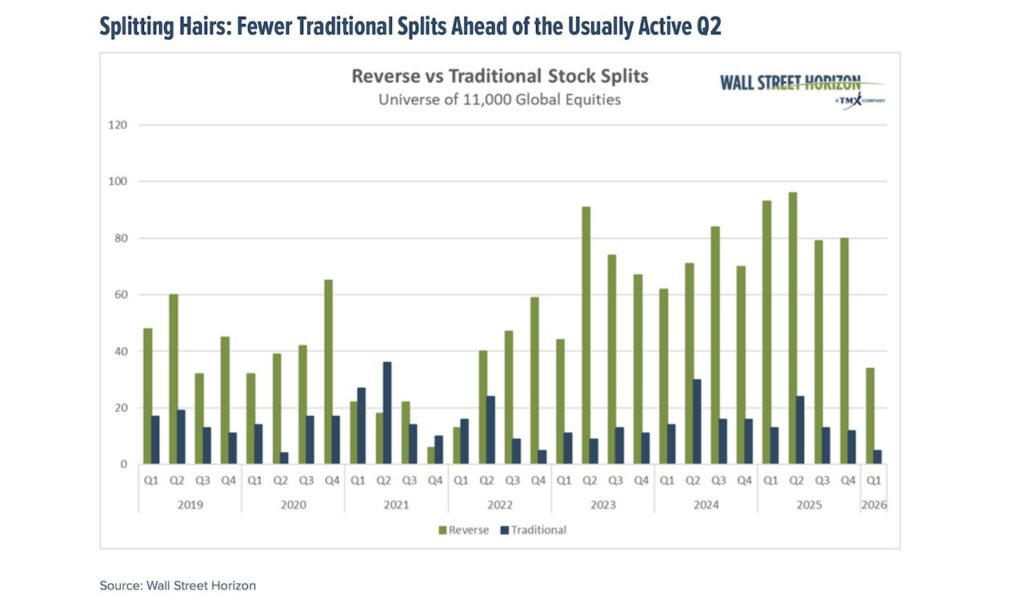
Splitting Hairs: Fewer Traditional Splits Ahead of the Usually Active Q2
Traditional stock splits are thought to make a firm’s shares more accessible to the retail crowd and can increase liquidity (lower trading costs). Arguably more importantly, the corporate action is seen as a confidence signal. Academic data point to short-run outperformance among splitters.
Reverse splits are sometimes done simply to meet exchange listing requirements, such as a minimum price rule. Companies also want to avoid penny stock perceptions in the market. So, from this angle, splits are like corporate body language, and it’s the job of portfolio managers to read between the lines.
A Curious Decline in Traditional Splits
We track this corporate event type. Our team looks for trends in traditional and reverse split announcement totals, and today, there appears to be a slowdown in traditional splits. That’s strange, considering that global stocks are near all-time highs.
The signal? Maybe there is more trepidation than CEOs and CFOs are letting on. What’s more, Q2 has historically been when bullish traditional split announcements peak. Thus, push may come to shove in the months ahead during the Q1 reporting season.
As for reverse splits, the quarterly count has been steady since 2023. Could that change after the drubbings so many AI-affected firms have faced in recent weeks? At the very least, it’s worth monitoring.
Booking’s Bold Move, Now at a 52-Week Low
So who are the winners and losers in the stock-split world right now? Perhaps surprisingly, Booking Holdings (BKNG), now at a 52-week low, announced it would execute a 25-for-1 split effective Thursday, April 2.
Having long been among the highest-priced stocks on the S&P 500, the Priceline.com owner reported mixed Q4 results on February 18. Executives noted strong growth as it harnesses AI technology, but the market was clearly not convinced. Now down more than 30% from its July 2025 all-time high, the split will take the stock from $3,895 to $156.
Recall that shares of travel companies were taken to the woodshed earlier this week amid fears of higher-end consumer weakness, but it wasn’t a new trend. It’s somewhat rare to see a traditional split announcement amid such weak price action. Be on the lookout for additional comments from the management team when it reports again on April 28 AMC (unconfirmed).
Consumer Cracks and Reverse Split Reality
Staying within the consumer space, the struggling restaurant chain Noodles & Company (NDLS) has been struck by the K-shaped economy. Once sporting a $600 million market cap, its equity value is now a mere $30 million. On February 4, it announced a 1-for-8 reverse stock split, which took effect on February 18.
The news came at the firm’s shareholders’ meeting, with the stock plunging from $5.16 to $4.40 the following session. Interestingly, NDLS bounced back from near $3.50 to above $5 in recent days. Its March 12 Q4 earnings date could be one to watch for those seeking high volatility.
AI Comes After Digital Marketing & Bitcoin’s Bear Market
Two other story stocks—Direct Digital (DRCT) and Bitcoin Depot (BTM)—executed sizable reverse splits earlier this year. Online advertising is on AI’s apparent hit list, while we all know crypto’s struggles since last October. DRCT reports earnings results on Tuesday, March 24 AMC (unconfirmed), while BTM Q4 results arrive on Tuesday, March 17 BMO (unconfirmed).
The Bottom Line
Both the 52-week high and 52-week low lists are filled with flyers and fallers right now. The equity world is “split,” so to speak. A few notable split announcements underscore the corporate landscape at the moment, and with more retail and consumer earnings on tap, don’t be surprised to hear more stock-split news.
Twitter: @ChristineLShort
The author may hold positions in mentioned securities. Any opinions expressed herein are solely those of the author, and do not in any way represent the views or opinions of any other person or entity.