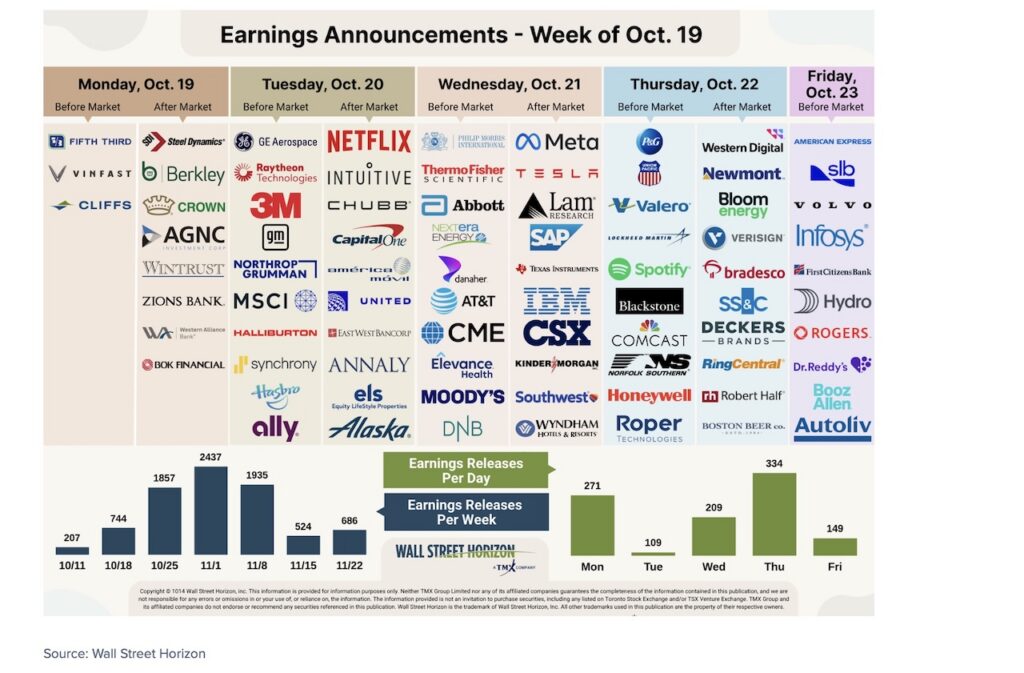
- Meta moved its Q3 report to October 21, a full week earlier than expected, a historically bullish move backed by surging enthusiasm for its new Muse AI models
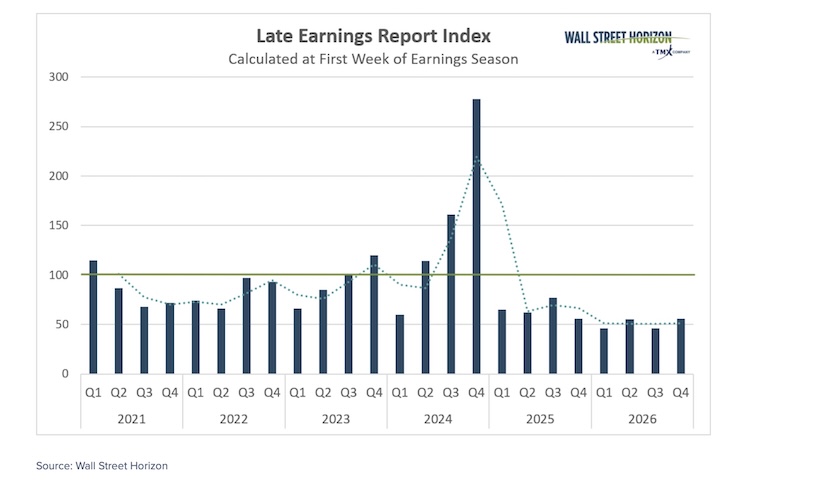
- The Late Earnings Report Index (LERI) sits at 56, well below the 100 baseline, signaling strong corporate clarity for an eighth straight quarter
- Over 1,000 global companies (including 79 S&P 500 members) are scheduled to report this week as earnings broaden beyond the financial sector
The third-quarter earnings season kicked off with a divergent performance across Wall Street, anchored by an unexpected double miss on both top and bottom lines from JPMorgan Chase.1
High bond yields severely muted fixed income trading across commercial giants like JPMorgan, Wells Fargo2, and Bank of America3. Conversely, equity trading desks and investment banking dealmaking at firms like Goldman Sachs4 and Morgan Stanley5 provided strong bright spots.
Ultimately, the early bank results highlighted a stark split: while high rates pressured fixed-income desks and funding costs, returning corporate dealmaking provided a critical growth engine.
This week, the focus expands to a broader swath of sectors, ranging from tech and industrials to consumer discretionary and energy, with 79 S&P 500 companies scheduled to report. Early results remain overwhelmingly positive: according to FactSet, of the 9% of S&P 500 companies that have reported so far, 84% have beaten EPS expectations, while 67% have topped revenue estimates. That early performance brings the blended Q3 EPS growth rate to 29.0%, a slight dip from last week but still positioning the index for potentially its third consecutive quarter of earnings growth above 25%.6
A Bullish Schedule Shift? Meta Sets Early Q3 Call Amid AI Agent Breakthroughs
All eyes are now turning to Meta Platforms (META), which is scheduled to report its third-quarter earnings on Wednesday, October 21. This release date marks Meta’s earliest Q3 report in a decade, arriving seven days ahead of our consensus (October 28) and pulling the tech giant out of the typical “Mega-Cap Tech Week” alongside Amazon, Apple, Microsoft, and Alphabet. It’s also pretty rare to see a company of this size move their earnings date so drastically, in either direction.
Historically, moving an earnings announcement forward is a distinctly bullish signal for investors. Academic research out of MIT and the University of Texas shows that when a company moves up its earnings release relative to historical norms, it strongly correlates with positive news being shared on the earnings call, whereas delayed reports often signal incoming bad news.7 By breaking away from its Big Tech peers to report early, Meta may subtly be signaling confidence to the market.
Ahead of its early earnings call, Meta’s stock took a slight downturn, falling nearly 3% last week in sympathy with the broader AI selloff. Year-to-date however the stock has shown strong upward momentum, up nearly 10% and within $10 of the all-time high seen in August 2025 ($786.80). Investor enthusiasm has been driven largely by the rollout of its new Muse AI models, leading analysts like Dan Ives of Yorkville Ives & Co. to argue that Meta may now be leading the AI race. In a recent note to clients, Ives highlighted Muse Wonder and Muse Wonder Full, emphasizing that breakthrough features like active memory and active focus allow the models to retain context and solve complex, multi-step problems autonomously. These capabilities mark a pivotal shift from simple Q&A tools toward true AI agents capable of handling sustained commercial assignments. Crucially, Meta holds a massive distribution advantage over competitors with 3.6 billion daily active users across its family of apps. By natively integrating these advanced models into existing touchpoints like WhatsApp and Ray-Ban Meta smart glasses, Meta can deploy agentic AI at scale while significantly undercutting user acquisition costs.8
Other Potential Surprises this week
In addition to Meta Platforms, there are three other S&P 500 companies with earlier than usual earnings dates this week. Rollins Inc. is also reporting October 21, a week earlier than the expectation of October 28. Western Digital Corp. will report on October 22, two weeks earlier than our initial estimate of November 5. Lastly, Comcast Inc. will also report on October 22, a week earlier than the forecasted date of October 29, but that is most likely due to the major spin-off taking place which result in two independent publicly traded companies (separating media/entertainment from broadband and wireless).
CEOs Remain Confident as Q3 Earnings Begin
CEO uncertainty remains low heading into Q3 reports, and in line with the readings from the first three quarters of the year. The Late Earnings Report Index, our proprietary measure of CEO uncertainty, has now recorded eight consecutive quarterly readings below the historical benchmark as companies prepare to report their Q3 results.
The LERI tracks outlier earnings date changes among publicly traded companies with market capitalizations of $250M and higher. The LERI has a baseline reading of 100, and anything above that indicates that companies are feeling uncertain about their current and short-term prospects. A LERI reading under 100 suggests that companies feel they have a pretty good handle on the near-term.
The official pre-peak season LERI reading for Q3 earnings (reported in Q4) stands at 56. This is well below the baseline reading, suggesting when companies announced their earnings dates they were feeling more certain about economic conditions. As of October 14, there were 37 late outliers and 60 early outliers.
Q3 2026 Earnings Wave
The peak weeks of the Q3 earnings season are expected to fall between October 26 – November 13, with each week expected to see over 2,000 reports. Currently, November 5 is predicted to be the most active day with 1,160 companies anticipated to report. Thus far, only 61% of companies have confirmed their earnings date (out of our universe of 11,000+ global names). The remaining dates are estimated based on historical reporting data.
Sources:
1 JPMorgan Chase Third Quarter 2026 Earnings Results, October 13, 2026, https://www.jpmorganchase.com
2 Wells Fargo Third Quarter 2026 Earnings Results, October 13, 2026, https://www.wellsfargo.com
3 Bank of America Third Quarter 2026 Earnings Results, October 14, 2026, https://d1io3yog0oux5.cloudfront.net
4 Goldman Sachs Third Quarter 2026 Earnings Results, October 13, 2026, https://www.goldmansachs.com5 Morgan Stanley Third Quarter 2026 Earnings Results, October 14, 2026, https://www.morganstanley.com
6 FactSet Earnings Insight, John Butters, October 16, 2026, https://advantage.factset.com
7 Time Will Tell: Information in the Timing of Scheduled Earnings News, Journal of Financial and Quantitative Analysis, Eric C. So, Travis L. Johnson, Dec, 2018, https://papers.ssrn.com
8 “Meta’s New AI Models Strengthen Investment Case, Dan Ives Says; $900 Target Maintained,” Citybiz, October 13, 2026, https://www.citybiz.co
Twitter: @ChristineLShort
The author may hold positions in mentioned securities. Any opinions expressed herein are solely those of the author, and do not in any way represent the views or opinions of any other person or entity.